Warehouse Management System
in Chennai
What comes in, where it sits, how it moves, how it goes out — and what comes back. A practical guide to the documents that keep warehouse stock honest, for operations across Chennai, Tamil Nadu and India.
3
Accuracy Documents
Both
Return Directions
5
Core Modules
3
Accuracy Controls
Unit
Level Traceability
3PL
Multi-Client Ready
What a Warehouse Management System Actually Controls
A WMS isn't a stock counter. It controls the full lifecycle of stock inside a warehouse: what comes in and how it's checked, where exactly it sits, how it moves shelf-to-shelf or site-to-site, how it leaves, and what happens when it comes back.
- Every movement is a document, not an edit
- Every document posts to one auditable stock ledger
- Nothing counts as available stock until it's put away
Why Chennai Warehouses Need It
A warehouse in the Ambattur or Oragadam belt rarely does one job — raw material for a plant, finished goods awaiting despatch, and stock held for a client often share the same roof. That mix is exactly where location-level tracking and per-client scoping stop records from drifting.
- Location-level visibility down to the shelf or bin
- Per-client segregation inside one physical building
- The same controls across a multi-state network
Complete Warehouse Capabilities
Receipt and putaway, stock accuracy, inter-warehouse movement, customer dispatch and the returns loop.
Zone & Location Tracking
Stock tracked to the specific shelf or bin holding it, not just "in the warehouse somewhere".
GRN, QC & Guided Putaway
Nothing counts as available stock until it has been received, checked and put away.
Approval-Gated Adjustments
Stock Transfers
Cycle Count Audits
Multi-Client (3PL)
Barcode-Verified Dispatch
Every pick-list line resolves to one specific labelled unit, scanned before it ships.
Customer & Supplier Returns
Both directions as formal documents, with batch and expiry carried through.
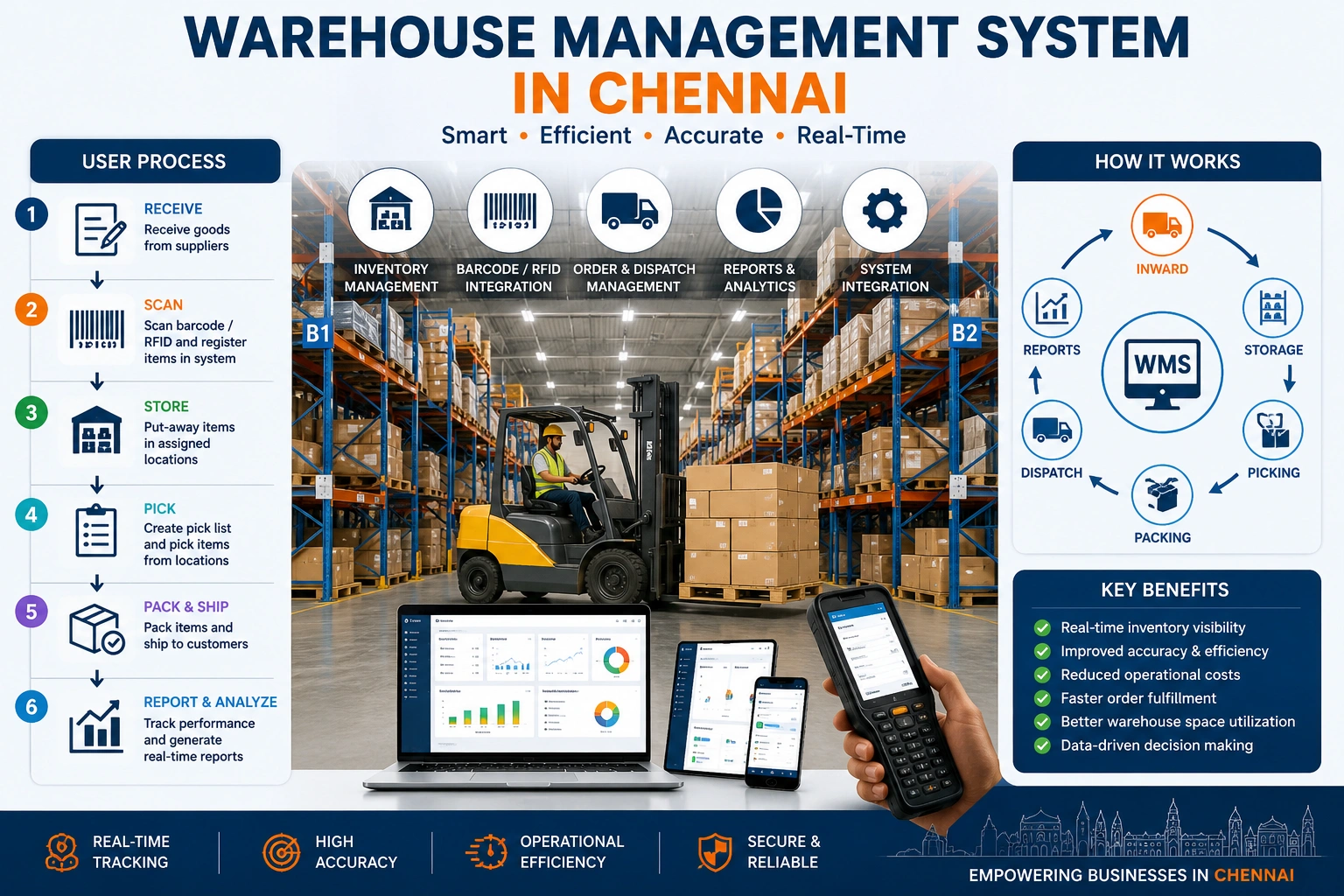
How It Works
Receive & Put Away
Goods arrive and are checked in via a Goods Receipt Note, optionally quality checked, then put away into a specific zone and location — only then do they count as available stock.
Stock Under Tracking
Stock sits under full location, batch and expiry tracking, with every movement recorded in the stock ledger.
Keep It Accurate
Stock Adjustments for damage, loss or found stock; Stock Transfers for relocation; Stock Audits that post their own variance on completion.
Raise Dispatch Order
Targeting either a customer or another of the company's own warehouses.
Generate Pick List
Generated automatically using the company's chosen picking strategy, resolving down to specific labelled units.
Scan, Issue & Gate Exit
An operator scans and issues each unit at Material Issue, optionally packing and loading it before Gate Exit.
Warehouse Transfer Receipt
For a dispatch-grade internal transfer, the receiving warehouse scans each unit in on arrival, completing the chain of custody.
Handle Returns
A Return Note captures items, batches and reasons for customer or supplier returns; posting moves the stock with batch and expiry intact.
Why Stock Accuracy Quietly Drifts
Stock records rarely break in one dramatic moment. They erode: a damaged carton nobody wrote off, a pallet moved to a different bay "just for now", and an annual stock take that arrives eleven months too late.
Stock Adjustment
The gapDamage, loss and found stock change the shelf with no transaction behind it.
The controlA reasoned, approval-gated document — Damage, Loss, Found, Correction or Other — preserving both recorded and adjusted quantity, moving stock only on posting.
Stock Transfer
The gapInformal shelf-to-shelf moves leave the system pointing at a bin the goods left days ago.
The controlOne document for shelf-to-shelf and site-to-site relocation, running Draft → In Transit → Completed so nothing is silently missing in between.
Stock Audit
The gapA once-a-year stock take means eleven months of drift before anyone checks.
The controlCounts run in routine slices by material, location or batch, snapshotting system quantity per line and posting the variance automatically on completion.
The Returns Loop, in Both Directions
Goods moving backwards are where most warehouse systems go quiet — and where stock accuracy usually dies.
Customer Return (Inbound)
- Goods back from a specific customer into a specific warehouse, with its own document number
- Captures material, quantity, batch and a reason for the return
- Batch and expiry carry through, so stock rejoins FEFO rotation
- Draft → Posted: stock moves only on the deliberate posting action
Supplier Return (Outbound)
- Rejected or defective material going back out to a supplier
- Same document type, same Draft → Posted discipline
- Reason captured per line, so returns are analysed by cause
- On a 3PL site, scoped to the right client's inventory automatically
WMS vs Manual Stock Tracking
| Factor | With a WMS | Manual Tracking |
|---|---|---|
| Damage & Loss | Reasoned, approval-gated adjustment posted to the ledger | Quantity edited in a sheet, cause unrecorded |
| Shelf-to-Shelf Moves | Transfer document with Draft → In Transit → Completed | Moved informally; system still points at the old bin |
| Stock Verification | Routine cycle counts posting variance automatically | Annual stock take, eleven months of drift |
| Inter-Warehouse Movement | Barcode-level picking plus Warehouse Transfer Receipt on arrival | Assumed received once the vehicle leaves |
| Returns | Formal Return Note with batch, reason and Draft → Posted | Goods put back on the shelf, batch identity lost |
What This Means on the Floor
Know Where It Actually Is
Location-level tracking down to the shelf or bin.
Attributable Write-Offs
Every adjustment carries a reason and an approval trail.
Accuracy Without Shutdowns
Cycle counts run in slices during normal operation.
Batch & Expiry Integrity
FEFO rotation holds, even for returned stock.
No Silent Gaps
In-transit stock is visible, not missing.
Unit-Level Traceability
Know exactly which label left the building, and when.
Fewer Write-Offs
Shrinkage analysed by cause instead of absorbed.
One Auditable Ledger
Every movement backed by a transaction somebody can point at.
Industries We Serve
Why Choose Teknovara for Warehouse Management?
WMS Consulting
Zone, location and putaway design fitted to your building.
Barcode Rollout
Unit-level labelling from goods-in through to despatch.
Stock Accuracy Setup
Adjustment reasons, approval chains and cycle-count cadence.
Multi-Warehouse Configuration
Transfers and receipts set up across every site.
3PL Client Scoping
Per-client segregation inside one physical warehouse.
ERP Integration
Stock and dispatch data synced with your existing ERP.
Onsite Support
Engineers available across Chennai.
Staff Training
Get floor teams confident from day one.
Nationwide Deployment
Rollouts supported across India.
Warehouse Management for Chennai and Pan-India Operations
Chennai sits at the meeting point of manufacturing and distribution — the Ambattur, Sriperumbudur and Oragadam industrial belts on one side, and port-adjacent logistics moving goods in and out on the other. Warehouses here rarely do just one job, and that mix is exactly where location-level tracking, per-client scoping and controlled adjustment documents matter.
For businesses running warehouses in more than one state, the same barcode-level picking and Warehouse Transfer Receipt process that confirms a movement between two Chennai sites applies unchanged across a multi-state network — stock stays traceable to its receipt, batch and putaway location wherever in India it lands.
Explore Related Solutions
Warehouse Management System
The full product — receipt to putaway, accuracy, dispatch and returns.
Learn moreFMCG Warehouse Management System
Weigh & label production with batch/expiry FEFO tracking.
Learn more3PL Warehouse Management Software
Multi-client warehousing with storage & handling billing.
Learn moreInventory Management System
Real-time inventory visibility and stock control.
Learn moreRFID Tracking System
RFID-based warehouse and asset movement tracking.
Learn moreBarcode Label Printing System
Industrial barcode and QR label printing software.
Learn moreWarehouse Management FAQs
A customer return is recorded as a formal Return Note against a specific customer and warehouse, capturing the material, quantity, batch and a reason for the return. Nothing touches stock while the document is in Draft — posting is the single action that writes the movement to the stock ledger, with batch and expiry carried through so the goods rejoin FEFO rotation correctly.
See Your Own Stock
Move Through the System
From goods receipt to a posted return — see how Teknovara's Warehouse Management System handles your materials, batches and warehouses across Chennai and India.
Warehouse Management System in Chennai
Teknovara provides a Warehouse Management System in Chennai for manufacturers, distributors and 3PL operators who need stock records that hold up. The platform combines zone and location tracking, goods receipt with quality control and guided putaway, barcode-level traceability, and batch and expiry control feeding FEFO picking.
Day-to-day accuracy rests on three controlled documents — stock adjustments with reasons and approval, stock transfers with in-transit visibility, and cycle-count stock audits that post their own variance — each writing to the same auditable stock ledger.
Whether you need warehouse-to-warehouse transfer management, barcode-verified customer dispatch, customer return handling or supplier return software, Teknovara delivers scalable warehouse systems tailored to operations across Chennai, Tamil Nadu and India.
Quick Facts
- Based in Chennai, serving warehouses across Tamil Nadu and India
- Adjustment, transfer and cycle-count controls as standard
- Multi-client (3PL) segregation inside one building
- Onsite support, deployment assistance and training included